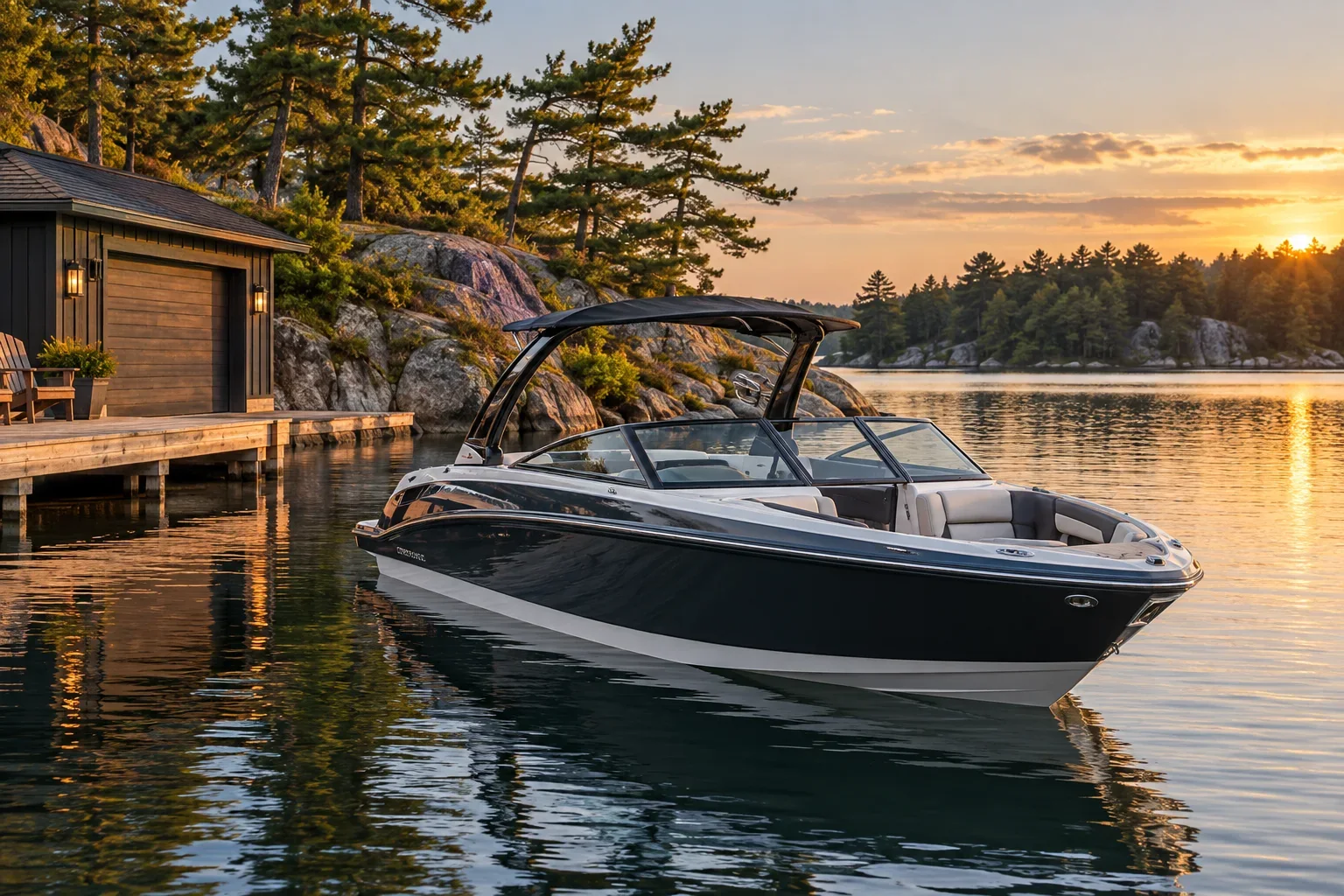
The boat. The open road. The home you’ve imagined. A well-structured loan can bring your plans forward while leaving more of your cash available for everything else.
Preserve your cashKeep room for life’s other priorities.
Plan your repaymentGive the purchase a defined schedule.
Get expert guidanceUnderstand the deal before you decide.
YOU DON’T HAVE TO PAY ALL AT ONCE
Cash in the bank. Possibilities on the horizon.
01
Keep a financial cushion.
Paying the entire purchase price today can tie up cash you may want for repairs, family needs or unexpected expenses. Financing part of the purchase lets you decide how much cash to commit upfront.
Keeping cash available has a borrowing cost. Choose a payment that fits your income and existing commitments.
02
Give your purchase its own plan.
A dedicated instalment loan separates this purchase from everyday revolving balances. Scheduled principal-and-interest payments work toward repayment. A fixed-rate option, when available, adds rate certainty for the agreed term.
If the term is shorter than the amortization, a balance remains at term end. Ask how it must be repaid or refinanced.
03
Put experience on your side.
DealerPlan brings underwriting expertise and attentive communication to your purchase. We work with your dealership and available lenders to explore a structure that fits the deal—and explain the costs, conditions and next steps.
Financing is subject to approval. Available rates and terms depend on your circumstances, the purchase and the lender.
AN ILLUSTRATION OF FLEXIBILITY
The same purchase. A different cash position.
Suppose you have $40,000 in savings and a $30,000 all-in purchase. Compare paying cash with putting $5,000 down and financing $25,000.
Pay the full $30,000 today$10,000cash remaining immediatelyPut $5,000 down$35,000cash remaining immediately, plus a $25,000 loan
Financing preserves $25,000 of cash upfront; it does not create savings or increase net wealth. Future payments, interest and any fees reduce the cash you retain over time. Illustrative figures only.
CHOOSE HOW YOUR MONEY WORKS
More than a way to pay.
Retail financing earns its place through structure, flexibility and support. Here’s how it compares.
VERSUS CASH
Keep more money accessible.
Retail financing lets you spread a large outlay over time instead of using the full amount of savings at once. A down payment can strike a balance between cash retained and interest paid.
When cash has the edge
Cash avoids loan interest and borrowing fees. If paying outright leaves a comfortable reserve, it may be your lowest-cost choice. Don’t assume investment returns will exceed your borrowing cost.
VERSUS ARRANGING A LOAN AT A BRANCH
Your purchase. Our area of expertise.
A branch conversation starts with the financing products that bank offers. For a boat, RV or powersports purchase, you’ll want to confirm whether its program fits the unit, the amount and the repayment period you need. If it doesn’t, you may need to approach another lender and start a new conversation.
DealerPlan brings the purchase and financing together. We understand these markets, explore available lender programs and work directly with your dealership on the purchase details, documentation and funding requirements. You have a team helping move the whole transaction forward.
Compare the structure—and the support.
Your branch may offer a competitive loan, particularly with an established banking relationship. Ask about eligible units, down payment, security, amortization, total borrowing cost and funding steps. We can help you compare the written terms. Neither route guarantees approval or the lowest rate. FCAC: dealer and bank financing routes ↗
VERSUS A PERSONAL LINE OF CREDIT
Keep everyday credit separate.
Use a dedicated loan for the purchase instead of drawing down an existing line of credit. The scheduled principal repayment can help you make consistent progress, without relying on interest-only minimums.
What to compare
A line of credit may have a lower rate and flexible repayment. Rates are usually variable, and paying only interest leaves the principal owing. A new loan still affects your debt load and future borrowing capacity. FCAC guidance ↗
For an eligible boat, RV or powersports purchase, ask about a loan secured by the unit rather than borrowing against your home. This can keep the purchase separate from your home-backed borrowing.
What to compare
A HELOC may cost less, but uses your home as security; most have variable rates. Retail loan security varies, and a lender may repossess a financed unit following default. Confirm the collateral and terms, especially for renovation financing. FCAC guidance ↗
These hypothetical examples repay the same $30,000 over 240 monthly payments (20 years). The retail example uses 8.99%; the line-of-credit example retains an assumed 6.00% for comparison. These are illustrations, not current rates or offers.
$30,000 borrowed · 20-year repayment · no additional borrowing
Illustrative option
Annual rate
Monthly payment
Total interest
Total repaid
Retail instalment loan
8.99%
$269.72
$34,733.97
$64,733.97
Line of credit, repaid over 20 years
6.00%
$214.93
$21,583.04
$51,583.04
The rate matters. So does the repayment plan.
The lower-rate line of credit costs $13,150.93 less in this example when repaid on the same 20-year schedule. Extended amortization reduces the retail payment but increases total interest compared with repaying the same loan sooner. Compare the full cost alongside the security required, rate certainty and purchase support.
Method: equal end-of-month payments, annual rate divided by 12, rates assumed unchanged for all 240 months and full repayment at the end. Totals use unrounded payments; displayed payments are rounded. No fees, optional products or additional charges are included. Lines of credit may calculate interest daily and use different minimum-payment rules. This models equal repayment periods, not minimum payments. A 20-year amortization is subject to lender, unit and applicant eligibility. If the loan term is shorter, a balance remains due at term end and refinancing terms may change.
A lower minimum payment. Not always a smaller borrowing impact.
Based on DealerPlan’s retail-financing experience, underwriters may count more than the interest-only minimum on a line of credit or HELOC. Their internal guidelines can allow for principal repayment as well as interest, or assess the facility as though more—or all—of its available credit has been used.
Illustration: $30,000 balance · retail loan at 8.99% over 20 years
Assessment assumption
Monthly amount counted
Revolving facility assessed at 3% of the balance
$900.00
Retail loan, if its contractual payment is accepted*
$269.72
$630.28 less counted each month at a 3% revolving assessment.
At a 2% assessment, the revolving obligation would be $600—$330.28 above the illustrated retail payment of $269.72. These are differences in qualifying obligations, not interest savings or additional income. The result depends on the lender accepting the contractual retail payment and its assessment of the revolving facility.
*The retail illustration uses $30,000 at 8.99% amortized over 240 months, with no fees and equal monthly payments. A 20-year amortization is an extended-payment option for eligible purchases, not a guaranteed minimum payment or approval. Availability and the loan term depend on the lender, unit and applicant. If the term is shorter than the amortization, a balance remains at term end. The 2–3% assessments illustrate the retail underwriting practice described by DealerPlan; lender policies vary. Every new loan remains a debt obligation.
Internal lender guidelines shape the result.
In DealerPlan’s experience, this approach is common in retail underwriting. Depending on the lender and facility, an underwriter may use an assumed monthly repayment—such as 2–3% of the balance—or assess exposure against the credit limit, including unused credit. This allows for principal repayment and the possibility of further borrowing, rather than relying only on today’s interest-only obligation.
A retail loan’s defined contractual payment can receive more favourable debt-service treatment when it is lower than the obligation assigned to the revolving facility. We help explain the structure and how it may be assessed. The lender’s current internal policy determines the calculation; the percentage, balance or limit used, and treatment of each facility can vary.
Tell us what matters: preserving cash, a comfortable payment, a shorter repayment period or flexibility to pay extra. We’ll explain the available options and help you compare them.
A longer amortization can lower the payment while increasing total interest and the risk of owing more than the unit is worth. Compare the rate, APR where provided, fees, amortization, term-end balance and early-payout conditions together. Read FCAC’s vehicle-financing guidance ↗
Optional protection is a separate choice. We explain what is offered and what it costs, so you know exactly what you’re agreeing to.
EXPERTISE BEHIND EVERY DEAL
See what financing could make possible.
Big purchase or everyday upgrade. Bring us your plans.
Reviewed September 12, 2026. General comparisons draw on the Financial Consumer Agency of Canada resources linked beside the relevant claims. The vehicle guidance explains general borrowing principles; product availability and security for boats, RVs, powersports and renovations must be confirmed with the lender. These sources do not endorse DealerPlan.
The cash illustration and loan comparison are DealerPlan educational examples calculated from the stated assumptions, not consumer survey results or lender quotes. Compare actual written offers before choosing. Financing is subject to lender approval and terms.